Loading...
Serving Springfield, IL and surrounding areas. (217) 572-9991
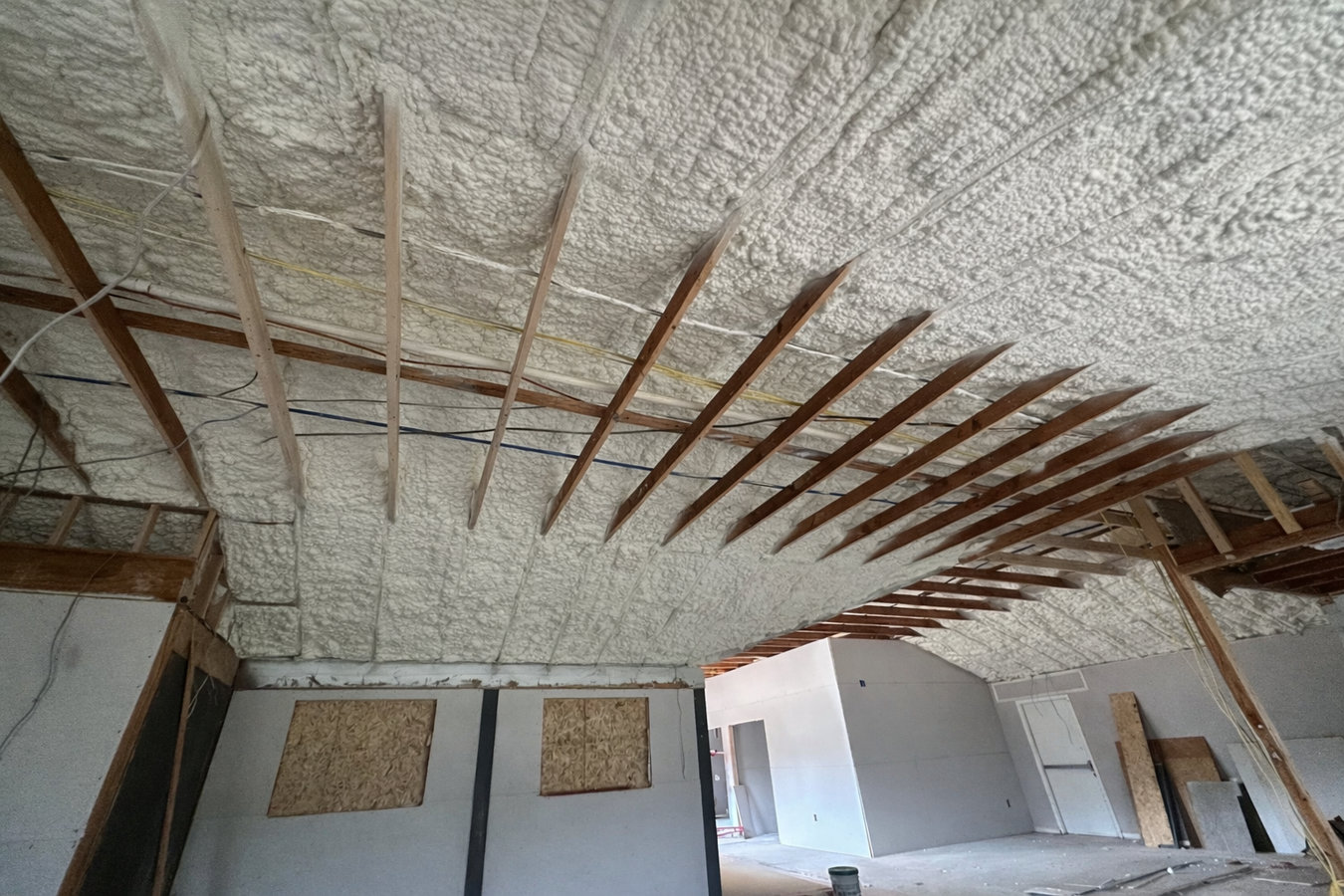
Open-cell spray foam fills every crack and gap in your walls and attic, stopping both heat loss and air movement in a single step so Springfield winters stop costing you extra.
Open cell spray foam insulation in Springfield is sprayed as a liquid that expands roughly 100 times its original volume to fill wall cavities, attic spaces, and rim joists - most residential jobs complete in one day, and the foam bonds permanently to the surfaces it touches without settling or shifting over time.
What makes open-cell foam different from fiberglass batts or blown-in cellulose is that it seals air leaks and insulates at the same time. In Springfield, where winters regularly drop below zero and summers push past 90 degrees with high humidity, air movement through gaps in walls and attics is often a bigger energy drain than the insulation value of the material itself. Open-cell foam addresses both problems in a single application. It is especially well-suited to above-grade spaces like attic floors, interior walls, and rim joists; for damp below-grade areas, your contractor may recommend spray foam insulation options that include closed-cell material instead.
The U.S. Department of Energy identifies air sealing as one of the most cost-effective energy improvements a homeowner can make, and open-cell foam delivers that air sealing built in to the insulation layer itself.
If your gas bill climbs sharply during the coldest weeks even though you have not changed your thermostat habits, heat is escaping and cold air is getting in. In Springfield, this kind of energy loss almost always traces back to gaps in the attic, rim joists, or wall cavities that insulation alone cannot fix without air sealing. Open-cell foam addresses both at once.
If a bedroom is always colder than the rest of the house in winter, or one room feels stuffy and humid all summer, the problem is usually uneven insulation or air leaks specific to that area. In Springfield's older housing stock, this is especially common in rooms above garages, finished attic spaces, or additions built onto the original structure.
Hold your hand near an electrical outlet on an exterior wall during a cold January day. If you feel cool air coming through, you have air leaks in your wall cavities. This is very common in pre-1980 Springfield homes, where exterior walls were often insulated with minimal fiberglass or left empty, and gaps around wiring were never sealed.
If your attic reaches extreme temperatures in summer or you have seen ice build up along your roof edge after a snowfall, heat is moving through your ceiling in ways it should not. Ice dams form when heat escaping through a poorly insulated attic melts snow on the roof, which refreezes at the cold eaves. Proper insulation and air sealing is the long-term fix.
We install open-cell spray foam in attic floors, interior wall cavities, rim joists, and cathedral ceilings. Because the foam expands to fill the entire space it is sprayed into, it reaches around old wiring, plumbing pipes, and framing irregularities that rigid batts leave exposed. That thoroughness is why spray foam consistently outperforms other materials in real-world conditions, even when the R-value numbers look similar on paper.
For existing walls in older Springfield homes, we drill small access holes, inject the foam, and patch the openings afterward. Most homeowners say the patches are barely visible after painting. This retrofit approach means you get the performance of open-cell foam without tearing out drywall or siding. It pairs well with our attic air sealing work, which targets the penetrations in your attic floor that open-cell foam in the walls does not cover.
Open-cell foam is also the right choice for interior walls between rooms where noise reduction is a priority, such as bedrooms, home offices, and media rooms. Because it is soft and porous, it absorbs sound rather than reflecting it, which is a side benefit many homeowners notice quickly after installation. For exterior walls and below-grade spaces where a moisture barrier is needed, we can discuss whether closed-cell spray foam is the better fit for those specific areas.
Best for homes with accessible attics where stopping heat loss through the ceiling is the priority.
Best for pre-1980 Springfield homes with uninsulated or under-insulated exterior walls.
Best for homes with cold floors above the basement or significant air infiltration at the foundation line.
Best for homeowners who want noise reduction between rooms in addition to thermal comfort.
Springfield sits in a climate zone where temperatures swing more than 100 degrees between the coldest winter nights and the hottest summer afternoons. That range puts constant pressure on your home's thermal envelope, and small air leaks that might be a minor inconvenience in a milder city become genuinely expensive here. Open-cell foam's ability to seal every gap and crack is especially valuable in Springfield, where the climate punishes any weakness in your insulation layer.
A large share of Springfield's housing stock dates from the 1920s through the 1970s, a period when insulation was minimal or nonexistent by today's standards. Neighborhoods like Iles Park, Aristocracy Hill, and the Ridgely area are filled with homes that have either empty wall cavities or degraded fiberglass that has settled and lost effectiveness. Open-cell foam can be retrofitted into these existing cavities without tearing out drywall, making it one of the practical upgrades available to owners of older Springfield homes. Homeowners in Lincoln and Jacksonville face the same older-housing challenges and access the same services.
Ameren Illinois, which serves most of Springfield, has historically offered rebates for qualifying insulation and air-sealing work. The Inflation Reduction Act also provides a federal tax credit for qualifying energy efficiency improvements. We help every customer identify which programs apply to their project and document the work so the rebate or credit is straightforward to claim. The Spray Polyurethane Foam Alliance sets the industry standards for installation quality that we follow on every job. Homeowners in Decatur are equally served and eligible for the same utility programs through their local provider.
We respond within 1 business day. A brief conversation covers the age of your home, which area you want insulated, and what problem you are trying to solve. No sales pressure, just a straightforward exchange to see if the service fits.
We come to your home and look at the actual space: the attic, wall cavities, or rim joists. We check for moisture issues, existing insulation, and any concerns like old wiring that need to be addressed before foam goes in. You receive a written estimate before agreeing to anything.
Depending on your project scope, a permit from the City of Springfield may be required. We handle that coordination on your behalf. If a permit is needed, factor in a few extra days for approval before the installation date is locked in.
The crew sets up, masks off surfaces, and applies the foam in passes to reach the right thickness. Most residential jobs finish in one day. Before leaving, the crew walks you through the finished work so you can see the coverage firsthand and ask questions while they are still on-site.
Free estimate, written quote, no obligation. We respond within 1 business day.
(217) 572-9991A large share of our work is in Springfield homes built before 1980, where irregular cavities, old wiring, and settled original insulation are the norm. We assess the existing structure before spraying rather than finding problems on installation day, so there are no surprises in your final invoice.
Every open-cell foam project comes with a written estimate and a clear record of the work performed. You know the scope and the materials before we start, and you have a direct point of contact throughout the job.
Springfield and Sangamon County homeowners have access to Ameren Illinois rebates and federal Inflation Reduction Act tax credits. We document every project so the paperwork is in order when you file. Across the dozens of projects we complete in this area annually, we know which programs apply and how to capture them.
You see the finished work before any drywall or covering goes back up. We walk you through the coverage, point out what was found and sealed, and answer any questions while the crew is still on-site. A contractor who will not show you the work before closing it in is not a contractor we would hire for our own homes.
Every one of these details matters more in an older city like Springfield, where the homes are not cookie-cutter and contractors without local experience can miss the details that determine whether an insulation job actually performs. We have been doing this work in central Illinois long enough to know what Springfield homes need.
Close the penetrations in your attic floor that allow conditioned air to escape before adding any insulation layer.
Learn moreFull spray foam options for both open-cell and closed-cell applications across every part of your home.
Learn moreWe have openings this month. Lock in your assessment before Springfield's next cold snap drives up demand.